Standard Two-Layer Approach in SupraNova
SupraNova organizes its bridging infrastructure into clearly separated functional layers, each responsible for a distinct part of the cross-chain communication process.
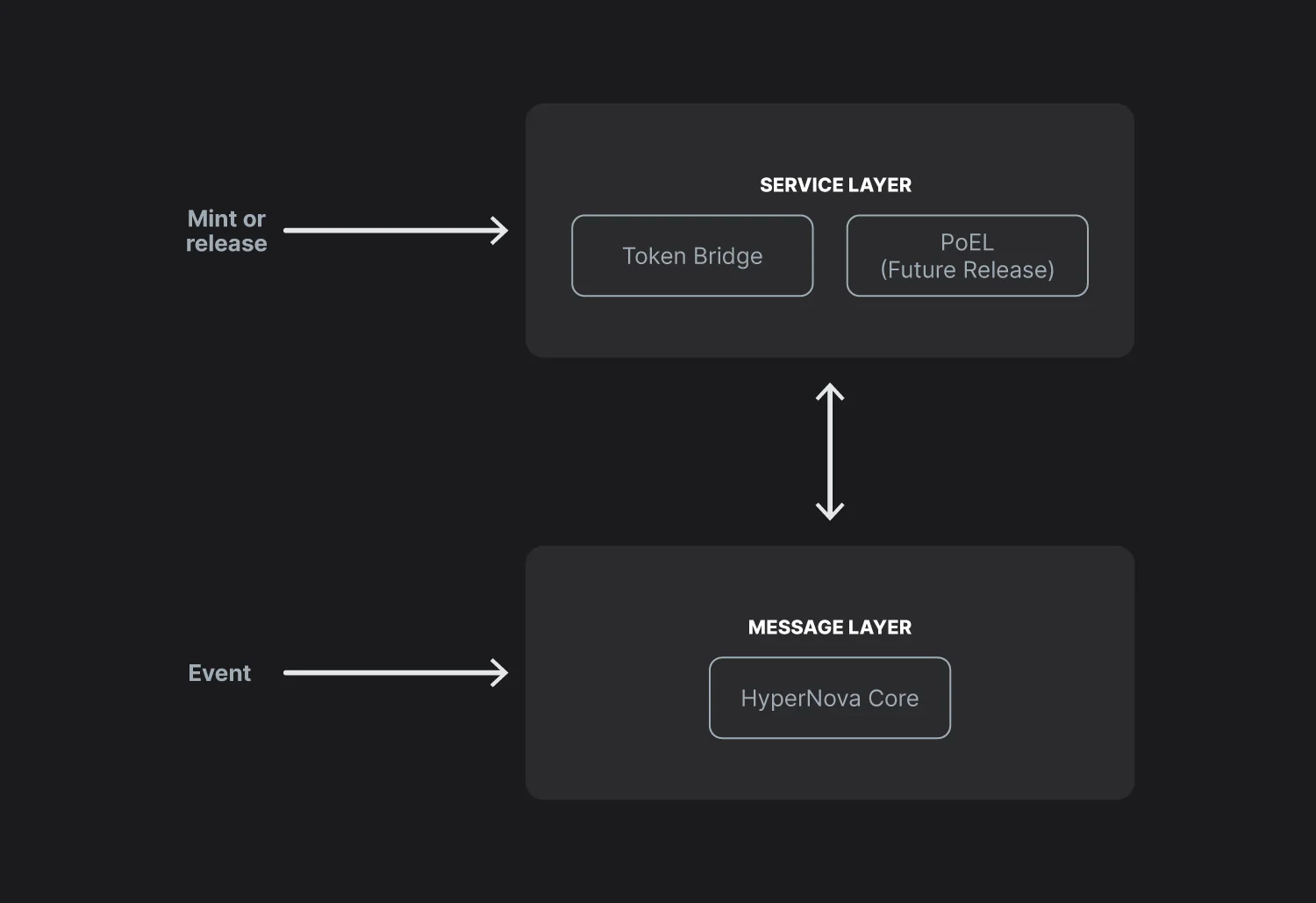
- The Message Passing Layer handles only the detection and verification of external blockchain events. It is operated by the HyperNovaCore protocol, which validates Ethereum events using cryptographic proofs like receipt proofs, and ancestry proofs. This layer remains lightweight and strictly focused on trustless message verification.
In case of HyperNova protocol, the message passing layer validates source chain validator signatures and membership
proofs.
In case of HyperLoop, the message passing layer validates the bridge validator signatures.
- The Service Layer sits above the Message Layer and consumes validated messages to perform application-specific actions. The Token Bridge, responsible for minting wrapped assets (like supETH) on Supra, is an example of a Service Layer application. Future services could also be built independently at this layer without touching core validation logic.
PoEL (Proof of Efficient Liquidity) operates over the validated event flow but will be covered in their own documentation.
This separation enables innovation at the Service Layer while maintaining strong cryptographic guarantees at the Message Layer.
Below you can find the architecture of Two- Layer Approach:
The Layers in Each Direction
The same separation applies to both bridging directions, with the layers instantiated on opposite chains.
| Layer | Ethereum to Supra | Supra to Ethereum |
|---|---|---|
| Message Passing Layer | HyperNovaCore verifier on Supra, validating Ethereum events with receipt, ancestry and Sync Committee proofs | HyperNovaCore verifier on Ethereum, validating Supra events with Merkle accumulator proofs and committee certificates |
| Service Layer | Token Bridge on Supra, minting the wrapped asset | Token Bridge on Ethereum, delivering the destination asset |
| Event source | Token Bridge on Ethereum takes custody and emits the bridge request | Token Bridge on Supra burns or locks the asset and emits the bridge-out request |
In both directions the service contract never validates proofs itself; validation always happens in the message passing layer.